Three hours of volunteer time. One permanent park for Mamelodi East
Mashadi Letwaba, Business Development Director
- FUNDER - Public Investment Corporation (PIC)
- NPO PARTNER - Backyard Farmers
- LOCATION - Smart Eco-Park 2, Gem Valley, Mamelodi East, City of Tshwane
- DATE - Mandela Month, July 2026
- EMPLOYEE TIME - 3 hours on site per volunteer
- COMPLIANCE - 100% of volunteer hours qualify as SED spend (B-BBEE)
- DELIVERED BY - forgood: sourcing, communication, logistics, verification and reporting
- GOVERNMENT PARTNER - City of Tshwane, with community leadership structures
A day that had to outlast itself
Mandela Day asks for 67 minutes. The ambition here was something a community would still be using in five years. The Public Investment Corporation put up the funding and sent its people, and briefed forgood to find a project with visible, lasting impact and a half-day commitment.
forgood found Backyard Farmers, a community environmental organisation in Gem Valley that had already turned one neglected open space into Smart Eco-Park 1. Their proposal was direct. A second space, Smart Eco-Park 2, was overgrown, unfenced and collecting illegal dumping. It could be a park again, if volunteers, residents and the City of Tshwane worked it together.
Where the need is dense
Stand at the gates and the case for the park makes itself. Smart Eco-Park 2 sits in Gem Valley, a growing residential node in Mamelodi East, part of one of South Africa's largest townships: the 2011 Census counted 334,577 people in 110,703 households across 45 km², a density of roughly 7,400 people per square kilometre, and the area has grown substantially since. Gem Valley is one of the newer parts of that growth, a full-title development where more than 800 homes have been sold to first-time buyers and young families.
That density is what makes a single park matter. Applying the census density figures, roughly 5,800 people in about 1,900 households live within a 500-metre walk of the park, and the catchment rises to an estimated 23,000 residents within a kilometre. Township age profiles run young, with close to three in ten residents under 15. That projects to around 1,700 children within 500 metres of the gates and over 6,500 within a kilometre, who now walk to a fenced, green, safe public space instead of an overgrown dumping ground.
These are planning estimates drawn from census density data rather than a headcount, and actual usage will be tracked through Backyard Farmers' ongoing monitoring. What they establish is simple: this park landed where the need is dense, visible and growing.
The day itself
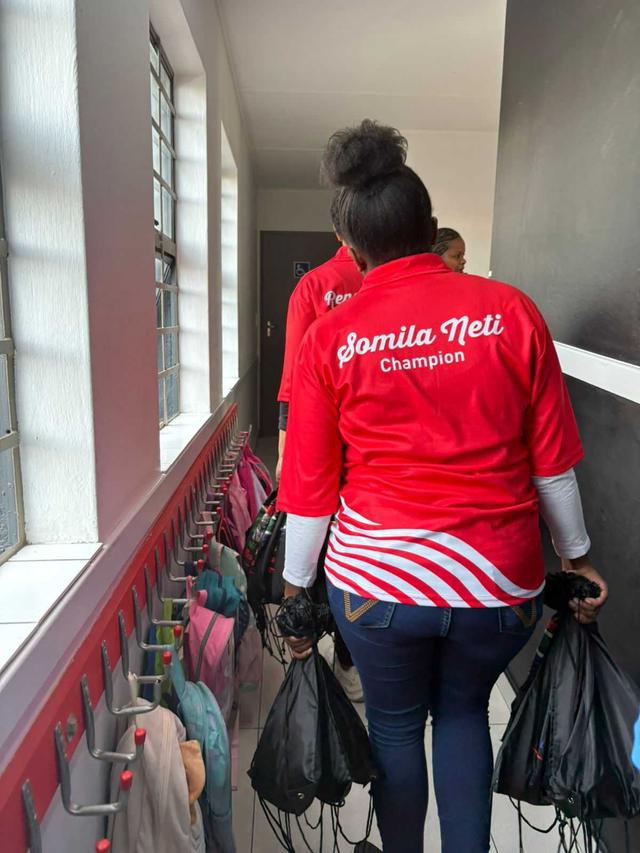
For three hours, residents, local youth volunteers, Backyard Farmers, City of Tshwane representatives and a team of PIC employee volunteers worked the site together. Backyard Farmers carried all the technical preparation and heavy work before and after, so the hours on site went straight into the visible transformation.
Environmental clean-up: litter and illegal dumping removed, overgrown grass and vegetation cleared
Beautification and landscaping: flowers, ornamental planting and indigenous trees planted, existing trees trimmed
Painting pot plants and varnishing benches
Recycling corner: a dedicated space where children learn how to sort and recycle waste
Food garden: vegetables planted for the surrounding community to harvest and use
Car wash: an informal wash that was already operating on the site, now formalised as an income stream for young men in the area
What changed
Before
After
What it left behind
What lasted is the park: cleared, planted, fenced and in daily use where a dumping ground used to be. It is also doing more than one job. Children use the recycling corner to learn how to sort and recycle waste, the food garden gives surrounding households vegetables they can harvest, and the car wash that was already operating on the site now runs formally, earning an income for young men in the area. Alongside it, the day produced team cohesion and purpose in a single half-day plus storytelling from a genuine community restoration.
The park keeps working long after the last volunteer left. Backyard Farmers continues environmental monitoring and community engagement, residents run maintenance, and the City of Tshwane partnership supports ongoing development. The value of the day keeps compounding well beyond it.
Why it worked
Three things made this work.
It was on site: volunteers stood in the community they were serving, and on-site work builds deep engagement and gives people a story they were part of.
The NPO led: Backyard Farmers had already proven the model at Smart Eco-Park 1, so volunteers plugged into a working system instead of improvising one.
And the ask was honest: three hours, everything else handled, every hour counted.
It shows up in the numbers. forgood clients average over 30% employee participation in volunteering programmes, against a global platform average of 13.6%. Activations like this one are a large part of the reason: when the work is real, local and visible, people show up.