What South African corporate volunteering looks like when it lasts
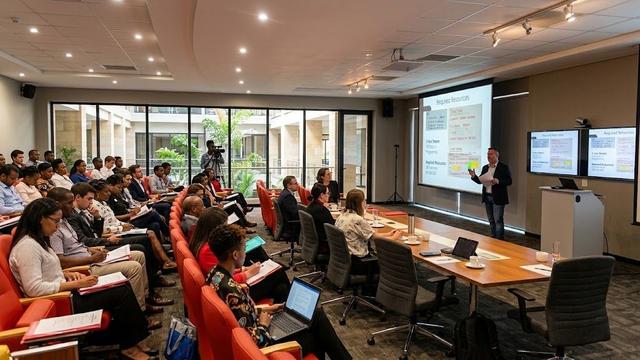
On Tuesday 6 October, forgood held a one-hour webinar hosted by CEO Romy Heldsinger, to mark the 2026 UN International Year of the Volunteer. Three South African organisations answered one question: what does corporate volunteering look like when it lasts? A live poll set the scene: 47% of attendees said volunteering at their company runs consistently year on year, 34% said it happens ad hoc, 13% have nothing formal yet, and 6% said it launched well but has faded.
Redefine Properties: from CSI to SED
Pearl Sekgobela, Socioeconomic Development Manager at Redefine Properties, explained that Redefine moved from corporate social investment (CSI) to socioeconomic development (SED) to work with stakeholders on long-term, sustainable solutions rather than once-off interventions. As she put it: “Gone are the days where we do our normal CSR, we go and we pose and we smile.” Its focus areas are community development, job creation, health and well-being, and education, aligned to the UN Sustainable Development Goals.
Volunteering sits inside Redefine’s purpose, “to create and manage spaces in a way that transforms lives”, and nearly half the company has taken part for four years running. The key, Pearl said, is finding creative ways that resonate with staff and matching what they enjoy to the causes on the platform.
The Red Thread is Redefine’s volunteering platform, connecting employees to verified causes where they can give time, skills, goods or money. Every second Friday, staff and the Red Thread Champions wear their Red Thread t-shirts and do micro-volunteering together, choosing opportunities that take less than ten minutes. Pearl credits this with changing the perception that volunteering has to be burdensome.
In the Q&A, Pearl explained that volunteering is measured through Redefine’s SED metric and audited every year. Participation is tracked on the forgood dashboard, and departments and individuals are rewarded at the year-end function.
Standard Bank: being seen
In a live interview with Romy, Manene Rigala, Head of Operations and MIS at Standard Bank and a 2024 and 2025 Impact Awards winner, described what changes when the company genuinely backs a volunteer. He has volunteered with Fun Learning for Youth (FLY) for a decade, supporting high school students from under-resourced communities. FLY has reached more than 3 000 learners.
His reason for saying yes was simple: “I’ve been backed before… I am who I am because of people.” He would have volunteered anyway, but the Impact Award changed what his commitment could achieve. He took the R100 000 prize back to FLY as a shared win, and the organisation invested it in its annual fundraising gala dinners, growing it into R1,5 million.
The recognition also reminded him “how great the place I work at is”, and shapes how he shows up at work: “Volunteering is commitment. It’s a decision that one makes to say, I’m going to give myself for free.” Romy’s takeaway: recognise one volunteer properly, and you get more volunteering, and more loyal volunteers, from the same gesture.
Momentum Group: from a day to a partnership
Tshego Bokaba, Lead: Group Foundation at Momentum Group, showed how Momentum moved from volunteering as a moment in time to a sustained partnership. Through the NPO Business Challenge, a non-profit identifies a real organisational challenge, such as strategy, finance, marketing or fundraising. Over two months, teams of Momentum employees volunteer their professional skills alongside the NPO, leaving tools and systems the NPO keeps using.
The programme has supported 34 NPOs over seven years. At the Frida Hartley Centre, volunteers raised funds for a container that is still in use as a training hub and office. At Empowerment Grace Foundation, they built a youth employment management system that is still active, and at Gift a Child Children’s Home, they developed a work-readiness programme for young people aged 15 to 24. The challenge used to run as a single day, but Momentum felt “there was something meaningful missing” and extended it to two months.
Her three lessons: good intentions are not enough, so listen first; expertise can be transformational because the greatest contribution is not always money; and the NPO must own the solution. Her measure of success is what happens after the volunteers leave.
What the three have in common
- Lasting beats once-off. Redefine moved from CSI to SED for sustained change, and Momentum swapped a single volunteering day for a two-month partnership.
- Make it easy to take part. Ten-minute micro-volunteering and a single platform keep participation steady without a big budget.
- Anchor volunteering in purpose, so it is part of the business and not an add-on.
- Give what you do best. Professional expertise can change an NPO more than money can, as long as the NPO owns the result.
- Recognise volunteers. Standard Bank’s Impact Award helped one volunteer turn R100 000 into R1,5 million for his cause, while Redefine rewards departments and individuals at year-end.
Watch the recording
If you missed it, watch the full recording below 👇🏾
Find out more about:
- Our business programmes on www.forgood.co.za/business and
- Click HERE to download our latest event ideas.